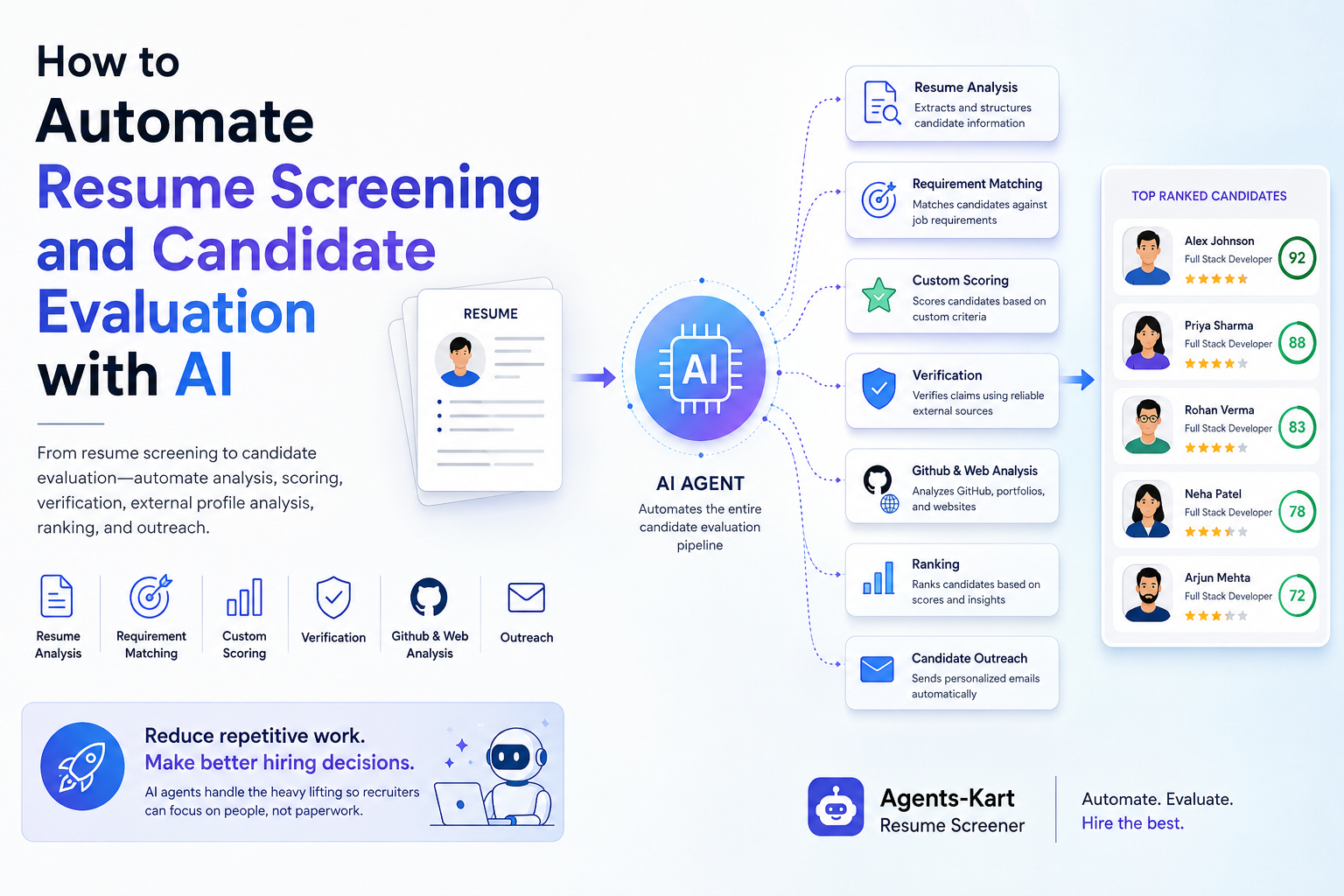
Evaluating candidates can involve much more than reading a resume.
A typical evaluation process may require reviewing resumes, comparing candidates against requirements, checking claims, examining portfolios or GitHub profiles, assigning scores, ranking candidates, and communicating with candidates.
TL;DR: Manual resume screening is slow and repetitive. AI agents can automate the entire candidate evaluation pipeline—including resume parsing, custom scoring, GitHub/portfolio analysis, claim verification, and personalized outreach—freeing recruiters to focus on final decisions.
When these steps are performed manually, the process becomes repetitive and time-consuming.
AI agents can automate many of these steps and turn candidate evaluation into a structured workflow.
What Is AI Resume Screening?
AI resume screening uses artificial intelligence to analyze candidate resumes and evaluate them against defined requirements.
Traditional keyword-based screening primarily looks for specific words or phrases. AI-based systems can analyze the broader context of a candidate's experience, skills, education, projects, and other information.
However, resume screening doesn't have to stop at the resume.
From Resume Screening to Candidate Evaluation
A resume is only one source of candidate information. A more complete evaluation workflow can combine:
- Resume analysis
- Requirement matching
- Custom scoring
- Candidate claim verification
- GitHub analysis
- Portfolio and website analysis
- Candidate ranking
- Automated communication
This allows the evaluation process to move beyond simply asking whether a keyword appears in a resume.
What Parts of Candidate Evaluation Can Be Automated?
1. Resume Analysis
AI can extract relevant information from resumes and organize it into structured candidate information.
2. Requirement Matching
Candidates can be evaluated against the requirements defined for a particular role or evaluation process.
3. Custom Scoring
Different organizations may value different qualifications. Custom scoring criteria allow you to define how different factors should contribute to the final evaluation.
4. Candidate Verification
Important claims can be identified and checked against available external information. This can help provide additional evidence when evaluating candidates.
5. GitHub Analysis
For technical candidates, publicly available GitHub information can provide additional context about repositories, projects, and coding activity.
6. Portfolio and Web Analysis
Candidate-provided websites and portfolio links can be analyzed to provide additional information beyond the resume.
7. Ranking Candidates
Once candidates have been evaluated, their scores and supporting information can be used to compare and rank them.
8. Candidate Outreach
The workflow can continue after evaluation by automating personalized candidate communication.
AI Resume Screening vs. Manual Screening
The goal of AI automation isn't necessarily to remove humans from the decision-making process.
Instead, AI can take care of repetitive evaluation work while people remain responsible for important decisions.
Instead of manually performing every step:
Read → Compare → Check → Research → Score → Rank → Email
an AI agent can automate much of the process.
How Agents-Kart Approaches Candidate Evaluation
Agents-Kart's Resume Screener combines resume analysis with customizable scoring, candidate verification, GitHub analysis, web analysis, ranking, and automated outreach.
The result is a workflow that goes beyond simple resume filtering and automates multiple repetitive steps involved in candidate evaluation.
The Future of Candidate Evaluation
As AI agents become more capable, individual automation tasks can be connected into larger workflows.
Resume screening can become one step in a broader candidate-evaluation process rather than an isolated task.
The objective isn't simply to process resumes faster. It's to reduce repetitive manual work while providing more information for better-informed decisions.
Frequently Asked Questions
Does AI resume screening introduce bias?
AI systems can inherit bias if not designed carefully. Modern AI evaluation agents focus on structured criteria matching rather than subjective inferences, providing more consistent scoring based strictly on job requirements and verifiable skills.
Can AI verify a candidate's claims?
Yes. An AI agent can cross-reference resume claims with external data points like public GitHub repositories, portfolio sites, and professional networking profiles to add a layer of verification.
Will AI replace human recruiters?
No. The goal of AI is to automate the repetitive, high-volume tasks of screening and scoring, so recruiters can spend more time interviewing and making nuanced hiring decisions.